Introduction
One of the most unique and profound concepts in Vedic philosophy is the idea that the Vedas are “Apauruṣeya” (अपौरुषेय) — meaning “not of human origin.”
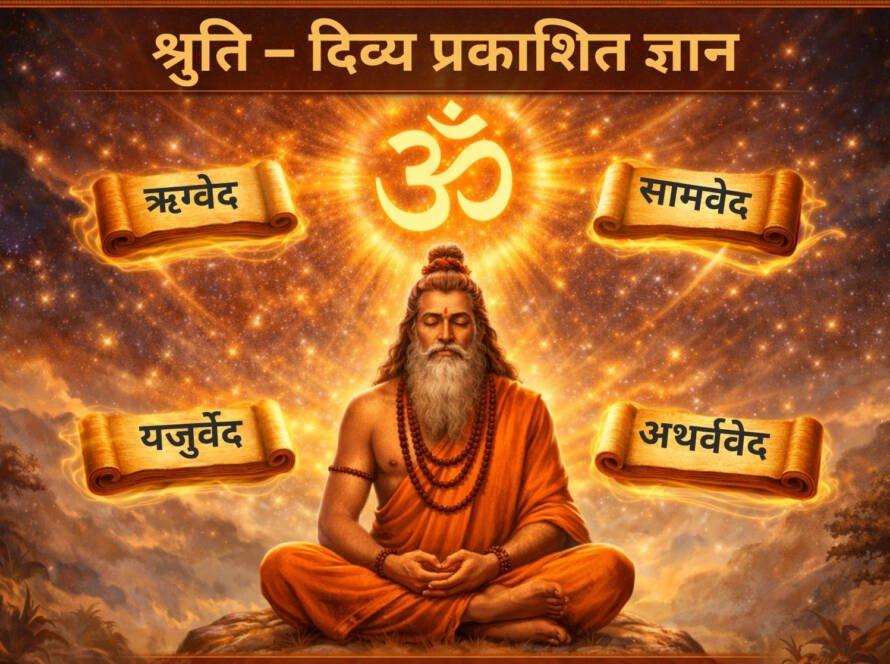
Unlike ordinary books, literature, or philosophical works written by individual authors, the Vedas are believed to be eternal truths that were revealed to ancient Ṛṣis (seers) through deep spiritual realization. The sages did not compose the Vedas; they merely heard, perceived, and transmitted them.
This belief forms the foundation of the authority and sanctity of the Vedas within Sanātana Dharma.
Meaning of the Word “Apauruṣeya”
The Sanskrit term can be understood as:
- “A” = not
- “Pauruṣeya” = originating from a person or human being
Thus, Apauruṣeya means:
- Not created by humans
- Beyond individual authorship
- Eternal and divine in origin
The Vedas are therefore regarded not as inventions of the human mind, but as manifestations of cosmic truth itself.
The Vedic View of Knowledge
According to Vedic philosophy, ultimate truth already exists eternally within the fabric of existence. Spiritual knowledge is not “created”; it is discovered or revealed.
Just as:
- Gravity existed before Newton discovered it,
- Mathematical truths existed before humans formulated them,
Similarly, the Vedic sages believed that spiritual laws and cosmic principles existed eternally before they were realized by the Ṛṣis.
The Ṛṣis were therefore called:
“Mantra-Draṣṭāraḥ” — The Seers of the Mantras
They were not authors (writers) of the mantras, but seers who perceived divine sound and truth through heightened states of consciousness.
How the Ṛṣis Received the Vedas
The ancient sages attained extraordinary levels of:
- Meditation
- Tapas (austerity)
- Purity
- Mental discipline
- Spiritual awareness
In deep states of samādhi, they experienced subtle cosmic vibrations and divine sound-consciousness. The mantras revealed in those states became the Vedas.
This is why the Vedas are called:
- Śruti — “that which was heard”
- Divine revelation
- Eternal wisdom
The process was considered spiritual perception rather than intellectual creation.
The Eternal Nature of the Vedas
The Vedas are believed to be:
- Beginningless
- Endless
- Timeless
According to Hindu cosmology, creation moves in endless cycles. At the beginning of every cosmic cycle, the same eternal Vedic wisdom is revealed again to enlightened sages.
Thus, the Vedas are not bound to:
- Historical periods
- Individual cultures
- Human personalities
They are viewed as universal truths underlying existence itself.
Sound as the Basis of Creation
Vedic philosophy deeply connects creation with sound vibration.
The universe is believed to emerge from primordial sound, especially the sacred syllable:
ॐ (Om)
Om is considered:
- The original cosmic vibration
- The sound-form of Brahman
- The essence of the Vedas
Since the Vedas are fundamentally collections of sacred sound patterns and mantras, they are seen as expressions of cosmic reality rather than human language alone.
This understanding strengthens the idea that the Vedas are divine revelations rather than human compositions.
Why Human Authorship Was Rejected
Several reasons contributed to the belief that the Vedas are not human-authored.
- No Individual Author
Unlike ordinary texts, the Vedas do not claim a single creator. Different hymns are associated with different Ṛṣis, but those sages are regarded as receivers of knowledge, not inventors.
- Extraordinary Preservation
For thousands of years, the Vedas were preserved orally with astonishing precision.
Complex recitation methods such as:
- Pada Pāṭha
- Krama Pāṭha
- Jatā Pāṭha
- Ghana Pāṭha
ensured that even pronunciation and tonal accents remained unchanged.
This careful preservation reflected the belief that every sound was sacred and divinely revealed.
- Depth Beyond Ordinary Human Thought
The philosophical depth of the Vedas and Upaniṣads — discussing:
- Consciousness
- Reality
- Infinity
- Existence
- Self-awareness
- Cosmic order
was considered beyond ordinary intellectual invention.
Philosophical Interpretations of Apauruṣeya
Different schools of Indian philosophy interpreted this concept in their own ways.
Mīmāṁsā School
The Mīmāṁsā philosophers strongly defended the eternal and authorless nature of the Vedas. They argued:
- Words and meanings are eternal
- Vedic sound exists independently of human beings
- The Vedas were never “composed”
For them, the Vedas themselves were the highest authority.
Vedānta School
Vedānta accepted the Vedas as divine revelation but focused especially on the Upaniṣads as sources of ultimate spiritual truth regarding Brahman and Ātman.
Modern Perspectives
Modern scholars often study the Vedas historically and linguistically, viewing them as products of ancient civilization and evolving oral traditions.
However, within the spiritual and traditional framework of Sanātana Dharma, the Vedas continue to be revered as:
- Eternal wisdom
- Divine revelation
- Sacred sound-consciousness
- Cosmic truth perceived by enlightened sages
Even today, many spiritual practitioners believe the Vedas contain truths that transcend historical authorship.
Spiritual Significance of Apauruṣeya
The concept of Apauruṣeya gives the Vedas their unique authority and sacredness.
If the Vedas are eternal truths rather than human opinions, then they become:
- A guide to universal reality
- A pathway to self-realization
- A source of spiritual liberation
- A bridge between humanity and cosmic consciousness
The Vedas are therefore not viewed merely as ancient literature, but as living spiritual knowledge.
Conclusion
The idea that the Vedas are Apauruṣeya lies at the heart of Vedic spirituality. It reflects the belief that ultimate truth is not invented by the human mind, but discovered through inner awakening and divine realization.
The Ṛṣis did not claim ownership over wisdom. Instead, they became silent instruments through which eternal knowledge flowed into human consciousness.
Thus, the Vedas are regarded as:
- Eternal
- Divine
- Authorless
- Universal
- And spiritually revealed
The doctrine of Apauruṣeya reminds humanity that the highest wisdom transcends ego, individuality, and time — existing eternally within the cosmic order itself.