Introduction
Rituals have been an integral part of every major spiritual tradition throughout human history. In the Vedic tradition, rituals (Yajñas, Pūjās, and sacred ceremonies) are not performed merely as religious customs or cultural practices. Every action, mantra, offering, and gesture carries a deeper symbolic meaning.
Without understanding their symbolism, rituals may appear to be mechanical actions or external ceremonies. However, when their inner significance is understood, they become powerful tools for self-transformation, spiritual awareness, and connection with the Divine.
The Vedic sages therefore emphasized that rituals should never be performed as empty formalities. Their true purpose lies not only in the external act but also in the inner understanding and intention behind it.
Symbolic explanation transforms ritual from a physical ceremony into a spiritual experience.
What is a Ritual?
A ritual is a structured sequence of sacred actions performed according to established spiritual principles.
In the Vedic tradition, rituals may include:
- Chanting mantras
- Lighting a sacred fire
- Offering flowers or food
- Pouring clarified butter (ghee) into the fire
- Circumambulation
- Meditation
- Prayer
Although these actions appear physical, each one represents a deeper spiritual truth.
The external ritual serves as a visible expression of invisible spiritual realities.
Why Symbolism is Necessary
Human beings naturally understand abstract ideas through symbols.
Concepts such as:
- Truth
- Purity
- Sacrifice
- Compassion
- Devotion
- Wisdom
cannot always be fully expressed through words alone.
Symbols provide a bridge between visible actions and invisible realities.
In the same way that a national flag represents an entire nation or a wedding ring symbolizes lifelong commitment, sacred rituals communicate profound spiritual ideas through symbolic actions.
Without symbolism, rituals lose much of their educational and transformative value.
External Action Reflects Inner Transformation
The Vedic tradition teaches that every external ritual corresponds to an inner spiritual process.
For example:
- Lighting a lamp symbolizes the removal of ignorance through the light of knowledge.
- Offering flowers represents offering one’s virtues and devotion.
- Burning incense symbolizes the spread of noble thoughts and pure character.
- Pouring ghee into the sacred fire symbolizes offering one’s ego, desires, and attachments to divine wisdom.
Thus, the real transformation occurs within the individual rather than in the ritual object itself.
Rituals as Spiritual Education
Rituals were designed not only for worship but also for teaching.
Through repeated participation, practitioners gradually learn:
- Discipline
- Gratitude
- Reverence
- Self-control
- Mindfulness
- Humility
Every ritual becomes a practical lesson in spiritual living.
Rather than merely explaining philosophical truths intellectually, rituals allow people to experience those truths through action.
Rituals and the Human Mind
The human mind learns through repetition, movement, sound, and visual symbols.
Vedic rituals combine all these elements:
- Sacred sound (mantras)
- Visual symbols (fire, lamps, flowers)
- Physical actions (offerings, prostration)
- Mental focus
- Spiritual intention
This integrated approach engages the body, mind, and emotions simultaneously, making spiritual teachings easier to internalize.
The Symbolism of Yajña
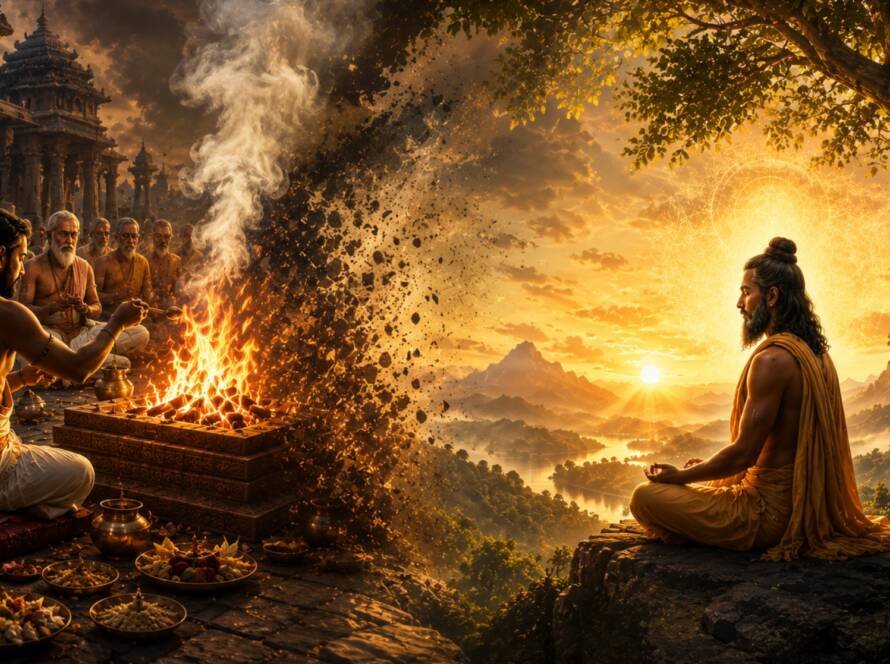
The Vedic Yajña provides one of the clearest examples of symbolic ritual.
Every component has philosophical significance.
- Fire (Agni) represents divine knowledge and purification.
- The altar symbolizes the universe.
- Offerings (Āhutis) symbolize surrender of ego and selfishness.
- Smoke symbolizes prayers rising toward the Divine.
- The sacred chants represent harmony between human consciousness and cosmic order.
Without understanding these meanings, Yajña may appear to be merely burning offerings in a fire.
With symbolic understanding, it becomes a profound meditation on self-purification and universal harmony.
Preventing Mechanical Worship
One of the greatest dangers in any religious tradition is performing rituals mechanically.
When symbolism is forgotten:
- Rituals become habits.
- Devotion becomes routine.
- Actions lose their spiritual depth.
- People imitate practices without understanding their purpose.
The Brāhmaṇas, Āraṇyakas, and Upaniṣads repeatedly encourage seekers to move beyond mechanical performance and discover the inner meaning behind sacred actions.
Understanding symbolism keeps rituals alive and meaningful.
From Outer Ritual to Inner Realization
The Vedic tradition presents a gradual spiritual journey.
Initially, a seeker performs external rituals.
Later, the seeker begins to understand their symbolic meaning.
Eventually, the ritual becomes internal.
For example:
- The external fire becomes the fire of knowledge.
- External offerings become the surrender of ego.
- The altar becomes the human heart.
- Worship becomes a continuous attitude of awareness.
This progression from outer practice to inner realization is one of the central themes of Vedic spirituality.
Symbolism and Universal Relevance
Because rituals communicate through symbols, their deeper teachings remain relevant across cultures and generations.
Even if specific ceremonial forms change over time, the underlying principles remain timeless:
- Selflessness
- Gratitude
- Discipline
- Compassion
- Purity
- Harmony
- Spiritual growth
The symbolic meaning continues to inspire long after the external form evolves.
Relevance in the Modern World
Modern life often emphasizes efficiency and external results, leaving little room for reflection and inner awareness.
The symbolic interpretation of rituals reminds us that every meaningful action can become sacred when performed consciously.
Daily activities such as:
- Lighting a lamp,
- Offering food,
- Helping others,
- Practicing meditation,
- Or serving society
can all become spiritual rituals when performed with understanding, gratitude, and selfless intention.
Thus, symbolism makes ancient rituals relevant to contemporary life.
Conclusion
Rituals are far more than traditional ceremonies. They are symbolic languages through which profound spiritual truths are expressed in visible form.
Their true purpose is not merely to perform sacred actions but to transform the individual performing them.
The Vedic sages understood that while rituals begin with external actions, their ultimate destination is inner realization.
The enduring message of Vedic ritual philosophy is that every sacred act becomes meaningful only when its external form is illuminated by inner understanding. When symbolism is understood, rituals cease to be mechanical practices and become living pathways to wisdom, self-transformation, and union with the Divine.