Introduction
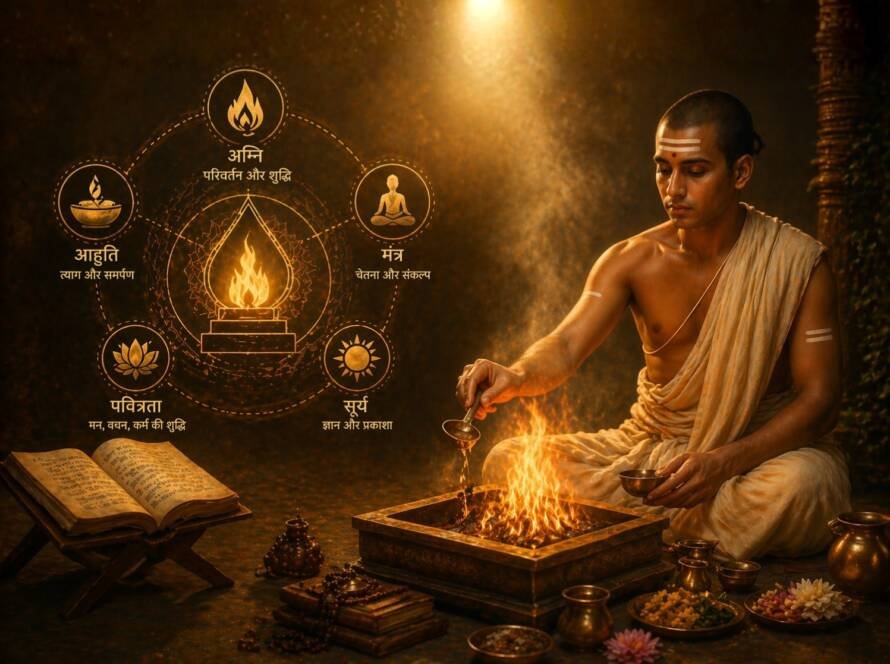
The concept of Yajña (Sacrifice) is one of the foundational ideas of Vedic philosophy. While Yajña is commonly understood as a sacred ritual involving offerings into a consecrated fire, the Vedas reveal a far deeper vision. They present the entire universe itself as a Cosmic Yajña—an eternal process of creation, preservation, transformation, and renewal.
According to the Vedic worldview, the universe is sustained through a continuous cycle of giving, receiving, sacrifice, and cooperation. Nothing exists independently; every element of creation contributes to the well-being of the whole. This universal principle is known as the Cosmic Yajña.
The Vedic sages understood that Yajña is not merely a religious ceremony performed by human beings. Rather, it is the fundamental law through which the cosmos functions. Every sunrise, every rainfall, every season, every breath, and every act of selfless service reflects this eternal sacrifice.
Thus, Cosmic Yajña transforms the idea of sacrifice from a ritual into a universal philosophy of life.
What is Cosmic Yajña?
The Sanskrit word Yajña derives from the root Yaj, meaning:
- To worship
- To offer
- To unite
- To cooperate
- To dedicate oneself for a higher purpose
In its deepest sense, Cosmic Yajña is the principle that the universe is sustained because every part willingly contributes to the existence of every other part.
Nothing in nature exists only for itself.
The sun gives light without expectation.
The rivers continuously flow.
Trees provide oxygen, fruits, and shelter.
The Earth nourishes all living beings.
Likewise, every living creature participates in the great cycle of mutual support.
The universe itself is an ongoing sacred offering.
The Universe as a Sacred Sacrifice
The Vedas describe creation not as a random event but as a carefully ordered process governed by Ṛta, the cosmic order.
Everything in nature participates in this order:
- The sun offers light.
- Clouds offer rain.
- Rivers offer water.
- Plants offer food.
- Animals maintain ecological balance.
- Human beings contribute through righteous action.
Every element receives from others and gives back in return.
This continuous exchange is the essence of Cosmic Yajña.
Life survives because everything participates in the universal cycle of giving.
The Puruṣa Sūkta and Cosmic Sacrifice
One of the earliest and most profound expressions of Cosmic Yajña appears in the Puruṣa Sūkta of the Ṛgveda.
The hymn describes the Cosmic Being (Puruṣa) whose symbolic sacrifice becomes the source of the universe.
From this cosmic sacrifice emerge:
- The Earth
- The heavens
- The directions
- The Moon
- The Sun
- The atmosphere
- Living beings
- Human society
The sacrifice described in the hymn is not an act of destruction but one of creative manifestation.
It teaches that creation itself is founded upon self-giving.
Every form of life exists because something greater has offered itself.
Yajña and Ṛta — The Cosmic Order
The Vedic concept of Ṛta refers to the universal order governing both nature and morality.
The Cosmic Yajña sustains this order through continuous balance.
Examples include:
- Day follows night.
- Seasons follow one another.
- Water evaporates, forms clouds, and returns as rain.
- Seeds become trees and produce new seeds.
These natural cycles demonstrate that the universe functions through reciprocity rather than isolation.
The Vedic sages understood these cycles as expressions of an eternal Yajña.
Nature as the Great Teacher
Nature itself provides the clearest example of Cosmic Yajña.
The Sun never asks for reward before giving light.
The Earth supports every form of life without discrimination.
Trees absorb carbon dioxide and release oxygen.
Rivers nourish civilizations while continuously giving of themselves.
Even the human body reflects this principle:
- The heart continuously pumps blood.
- The lungs exchange oxygen.
- Every organ serves the whole body.
Each part exists by serving something greater than itself.
The universe flourishes because everything participates in mutual giving.
Human Life and Cosmic Yajña
Human beings are not separate from this universal process.
The Vedas teach that every individual has the responsibility to consciously participate in the Cosmic Yajña.
This participation occurs through:
- Performing one’s duties honestly.
- Serving society selflessly.
- Protecting nature.
- Sharing knowledge.
- Practicing compassion.
- Living according to Dharma.
Every righteous action becomes an offering to the universal order.
Thus, daily life itself can become a sacred Yajña.
The Bhagavad Gītā and Cosmic Yajña
The philosophy of Cosmic Yajña is beautifully developed in the Bhagavad Gītā.
Lord Kṛṣṇa explains that the entire cycle of life depends upon sacrifice.
He teaches that:
- Sacrifice sustains nature.
- Nature produces food.
- Food sustains living beings.
- Human beings must contribute back through selfless action.
Actions performed only for personal gain create bondage, whereas actions performed in the spirit of Yajña promote harmony and spiritual freedom.
The Gītā expands the Vedic idea of sacrifice from ritual fire to every aspect of righteous living.
Inner Meaning of Cosmic Yajña
The deepest meaning of Cosmic Yajña lies within the individual.
The real sacrifice is not merely offering external objects.
It is the offering of:
- Ego
- Pride
- Selfish desires
- Attachment
- Ignorance
into the fire of wisdom.
Every act of self-improvement becomes an inner Yajña.
As selfishness diminishes, compassion, wisdom, and inner freedom naturally arise.
Relevance in the Modern World
The concept of Cosmic Yajña is profoundly relevant today.
Modern society often emphasizes consumption, competition, and individual success.
The Vedic vision reminds us that lasting prosperity depends upon cooperation rather than exploitation.
Its principles encourage:
- Environmental responsibility
- Sustainable living
- Ethical leadership
- Social harmony
- Community service
- Gratitude toward nature
The ecological crises of the modern world highlight the importance of restoring the spirit of mutual giving embodied in the Cosmic Yajña.
Conclusion
The Vedic concept of Cosmic Yajña teaches that sacrifice is not confined to sacred rituals—it is the very principle upon which the universe operates.
Every element of creation participates in an eternal cycle of giving, receiving, and renewal. Nature demonstrates that harmony arises not through selfish accumulation but through selfless contribution.
Human beings fulfill their highest purpose when they consciously participate in this universal sacrifice through righteous action, compassion, service, and gratitude.
The timeless message of Cosmic Yajña is that life flourishes when we recognize that we are not isolated individuals, but participants in a sacred cosmic order where every act of selfless giving sustains the harmony of the universe.