Introduction
The Āraṇyakas are traditionally described as the literary bridge between the Brāhmaṇas, which explain Vedic rituals, and the Upaniṣads, which expound the philosophy of Self-realization. While this description is accurate, it captures only part of their significance.
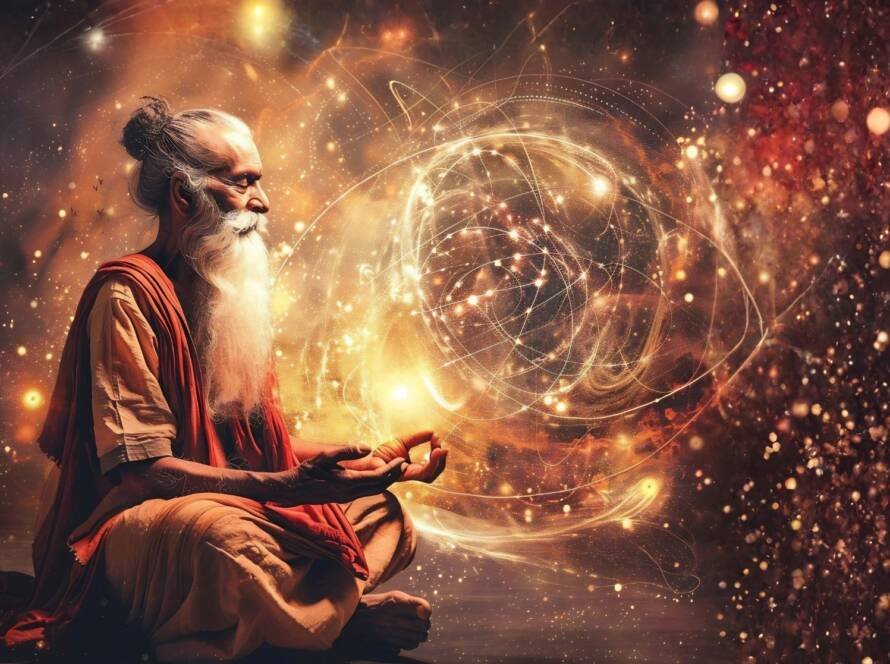
The Āraṇyakas are far more than transitional texts. They represent one of humanity’s earliest explorations of the inner world of consciousness, transforming external rituals into symbolic maps of the human mind. Instead of merely explaining how rituals should be performed, they explore why rituals exist and what psychological and spiritual transformation they are intended to produce.
Viewed from this perspective, the Āraṇyakas can be understood as some of the earliest psychological texts in world literature—not psychology in the modern scientific sense, but profound studies of the human mind, consciousness, symbolism, and inner growth.
From Ritual to Consciousness
The Brāhmaṇas primarily explain the procedures and philosophy of Vedic sacrifice.
The Āraṇyakas shift the focus.
Their central concern becomes:
What happens within the individual while performing a sacred ritual?
This marks a revolutionary development.
The true altar is no longer only the external sacrificial ground.
It is the human heart.
The true fire is no longer only physical Agni.
It is the fire of awareness.
The true offering is no longer merely clarified butter or grains.
It is the surrender of ignorance, ego, attachment, and selfish desires.
Thus, the Āraṇyakas redirect attention from external actions to the transformation of consciousness.
The Human Mind as the Sacred Field
One of the most remarkable contributions of the Āraṇyakas is their recognition that spiritual growth begins within the mind.
Rather than treating rituals as independent religious acts, they view them as symbolic practices that gradually reshape:
- Thoughts
- Emotions
- Perception
- Intentions
- Awareness
The external ceremony becomes a training method for cultivating an awakened mind.
Every ritual acquires psychological significance.
Symbolism as a Language of the Mind
The Āraṇyakas rarely abandon ritual symbolism.
Instead, they reinterpret it.
Examples include:
- Fire symbolizes knowledge that destroys ignorance.
- Light represents awakened consciousness.
- Breath (Prāṇa) represents the vital force connecting body and mind.
- The altar symbolizes the human personality.
- Sacrifice symbolizes the transformation of the ego.
These symbols are not arbitrary.
They function as psychological tools that help the seeker understand invisible inner processes through visible actions.
The Journey Inward
The Āraṇyakas encourage seekers to move from observation of the external world toward observation of the inner self.
Questions gradually change from:
- What should I do?
to
- Why do I act?
- Who experiences these thoughts?
- What is the source of awareness?
- What remains when desires disappear?
These inquiries prepare the mind for the philosophical investigations of the Upaniṣads.
Meditation as Inner Observation
Unlike earlier ritual texts, the Āraṇyakas increasingly emphasize:
- Silence
- Contemplation
- Meditation
- Breath awareness
- Reflection
These practices are intended to observe the movements of the mind rather than merely perform sacred ceremonies.
The seeker begins to witness thoughts instead of identifying with them.
This represents an early exploration of conscious self-observation.
Understanding the Ego
Although the Āraṇyakas do not use modern psychological terminology, they repeatedly point toward the limitations of ego and attachment.
They teach that suffering arises when the individual becomes excessively identified with:
- Possessions
- Social identity
- Ritual performance
- Personal desires
- External achievements
True sacrifice therefore becomes the gradual surrender of these limiting identifications.
This inner transformation becomes more important than external ritual precision.
The Forest as a Psychological Symbol
The “forest” (Araṇya) carries profound psychological meaning.
It is not simply a geographical location.
The forest symbolizes:
- Inner silence
- Freedom from distraction
- Simplicity
- Self-reflection
- Withdrawal from constant sensory stimulation
Entering the forest represents entering one’s own inner world.
The real journey is not from the village to the forest, but from mental distraction to inner awareness.
Preparing the Mind for Self-Realization
The Āraṇyakas do not directly present the highest metaphysical teachings.
Instead, they prepare the mind to receive them.
By cultivating:
- Inner discipline
- Symbolic understanding
- Meditation
- Self-observation
- Mental purity
they make the seeker ready for the Upaniṣadic realization that Ātman and Brahman are ultimately one.
Thus, psychological preparation becomes the foundation for philosophical realization.
Relevance in the Modern World
Modern psychology seeks to understand thoughts, emotions, identity, and consciousness.
Although developed in a very different historical context, the Āraṇyakas explore many of these same inner dimensions through symbolic and spiritual language.
Their teachings encourage individuals to:
- Observe the mind.
- Understand the motives behind actions.
- Transform destructive tendencies.
- Cultivate self-awareness.
- Live consciously rather than mechanically.
Their approach reminds us that lasting change begins within.
Conclusion
The Āraṇyakas should not be understood merely as transitional texts connecting ritual to philosophy. They are profound explorations of the human mind and the psychology of spiritual transformation.
By interpreting rituals as symbols of inner growth, they shift the focus from external ceremonies to the awakening of consciousness. They teach that every sacred act ultimately points inward, inviting the seeker to examine the mind, refine character, and discover the deeper reality hidden beneath ordinary experience.
The enduring message of the Āraṇyakas is that the greatest ritual is the transformation of consciousness. When the mind itself becomes the altar, awareness the sacred fire, and the ego the offering, every moment of life becomes a step toward Self-realization and union with the Divine.