- Meaning of Apauruṣeya
The Sanskrit word Apauruṣeya is composed of three parts:
- A – not
- Puruṣa – human or person
- Apauruṣeya – not created by any human being
Thus, Apauruṣeya refers to knowledge that is not authored or composed by a human mind, but is eternal and inherent in the structure of reality.
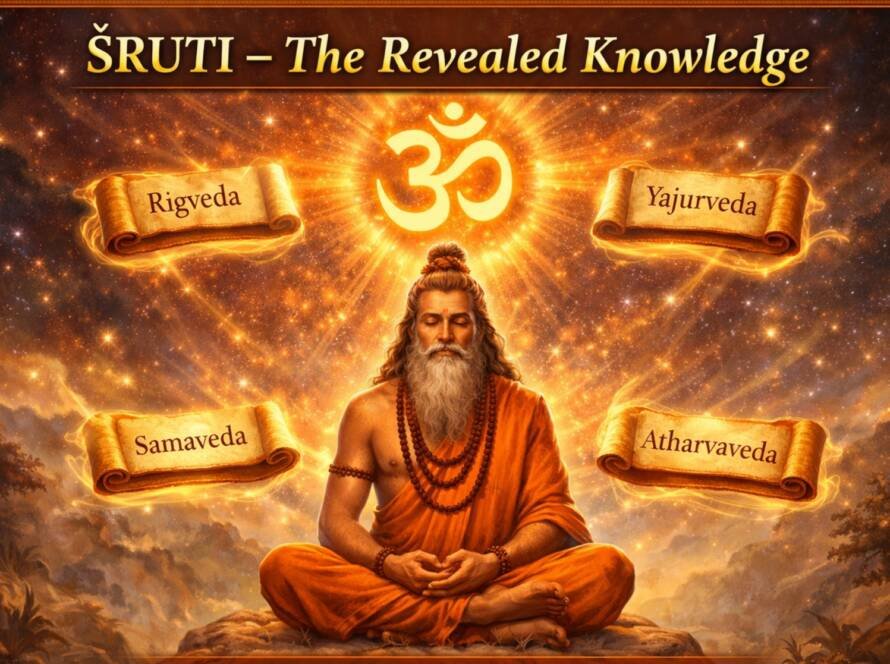
In the tradition of Sanātana Dharma, the Vedas are regarded as Apauruṣeya, meaning they were not written by any individual author. Instead, they were perceived and realized by ancient sages (ṛṣis) through profound spiritual insight.
- Ṛṣis – Seers, Not Authors
A fundamental concept associated with the Vedas is that of the Mantra-dṛṣṭā — the seer of the mantra.
The ṛṣis were not considered authors of the Vedas. Rather, they were seers who experienced the mantras during deep meditation and spiritual realization.
This implies that:
- The mantras already existed
- The sages perceived them in states of heightened consciousness
- They transmitted this knowledge to humanity
Thus, the Vedas are not products of human imagination but expressions of truths discovered through spiritual perception.
- The Vedas as Eternal Knowledge
According to Sanātana philosophical thought, the Vedas are eternal (anādi and ananta). This does not mean that they were written at a particular historical moment. Rather, the knowledge they contain has always existed as part of the cosmic order.
Just as:
- The law of gravity existed before it was discovered
- Mathematical principles existed before humans formulated them
Similarly, the truths contained in the Vedas are timeless realities embedded within the universe itself.
The sages merely recognized and articulated these truths.
- The Concept of Śruti – Knowledge Heard
The Vedas belong to the category of Śruti, meaning “that which is heard.”
This term reflects the belief that the sages heard or received the Vedic mantras in states of profound spiritual awareness.
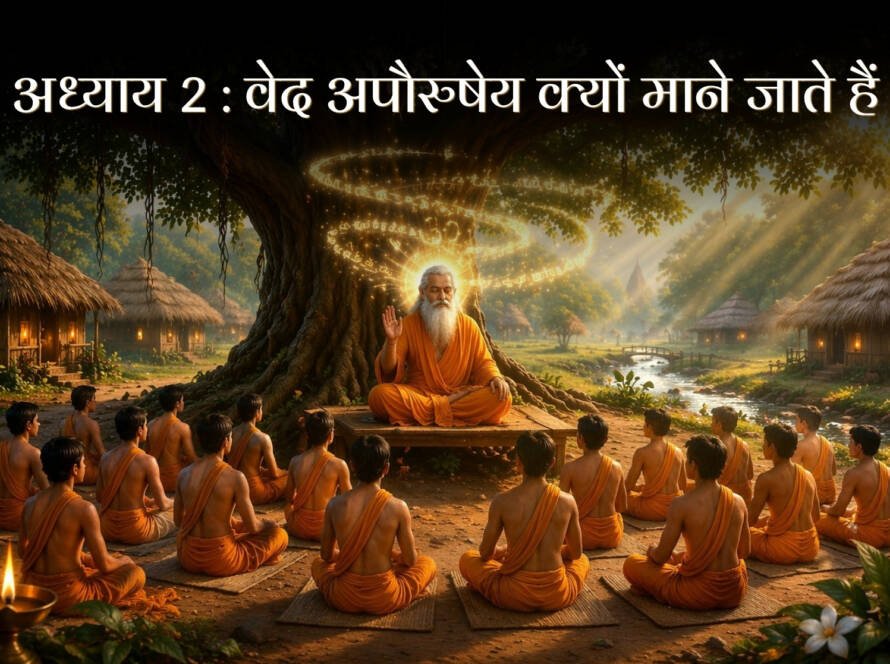
The knowledge was then transmitted through the Guru–Śiṣya (teacher–disciple) tradition, ensuring continuity and accuracy across generations.
Through this sacred oral tradition, the Vedas were preserved for thousands of years before being written down.
- The Eternity of Sound
Another reason the Vedas are considered Apauruṣeya lies in the concept of eternal sound.
In Vedic philosophy, sound (Śabda) is regarded as a fundamental principle of creation. The universe itself is believed to emerge from vibration or cosmic sound.
Vedic mantras are therefore not merely linguistic expressions. They are specific vibrational patterns that carry spiritual power and meaning.
This idea is often described as Śabda-Brahman — the ultimate reality manifesting through sacred sound.
- Philosophical Foundations
Several schools of Indian philosophy provide intellectual support for the concept of the Vedas being Apauruṣeya.
Pūrva Mīmāṁsā
The Pūrva Mīmāṁsā school strongly argues that:
- The Vedas are eternal
- Words themselves are eternal
- Therefore, the Vedas must also be eternal
According to this philosophy, if the Vedas had a human author, they would be subject to human limitations and error. Their precision and consistency across centuries indicate their transcendent origin.
Vedānta
Vedānta accepts the Vedas as the ultimate source of spiritual knowledge. It teaches that Vedic wisdom manifests at the beginning of each cosmic cycle and is revealed to sages who then preserve and transmit it.
- The Relationship Between Veda and the Divine
It is important to understand that calling the Vedas Apauruṣeya does not mean that they are a book written directly by a deity.
Rather, the Vedas represent universal principles that arise from the very structure of reality.
They express the cosmic order and spiritual truths that govern existence.
- The Oral Tradition of Preservation
To ensure the accuracy of this sacred knowledge, ancient India developed extremely sophisticated oral preservation techniques.
Some of these include:
- Padapāṭha
- Kramapāṭha
- Jaṭāpāṭha
- Ghanapāṭha
These methods ensured that the pronunciation, order, and sound structure of the mantras remained unchanged over thousands of years.
- Significance of Apauruṣeyatva
The concept of the Vedas being Apauruṣeya has profound implications.
Because the Vedas are not attributed to any individual:
- Their authority is universal rather than personal
- Their teachings transcend time and culture
- They serve as a foundational reference for all later scriptures
Thus, the Vedas are regarded as the highest source of spiritual and philosophical knowledge in Sanātana Dharma.
- Conclusion
The doctrine of Apauruṣeyatva emphasizes that truth is not invented but discovered.
Through deep meditation, discipline, and spiritual insight, the ancient ṛṣis perceived the eternal principles of existence and expressed them as Vedic mantras.
For this reason, the Vedas are not merely ancient texts; they are timeless reservoirs of wisdom, preserved through devotion, scholarship, and an unbroken lineage of transmission.
End of Chapter 2