Introduction
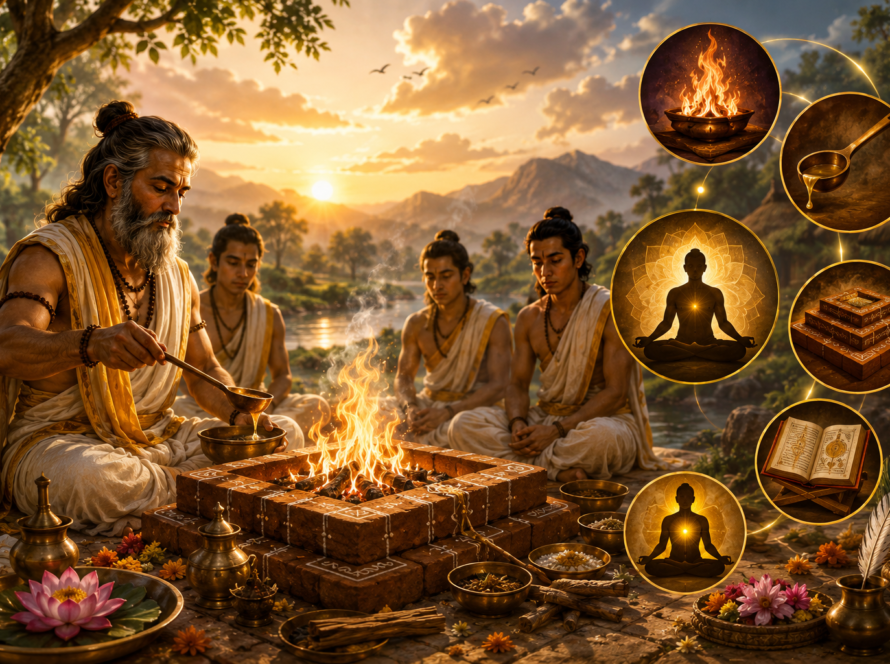
In the vast spiritual heritage of India, the term Śruti (श्रुति) holds the highest place of authority and sanctity. The word Śruti literally means “that which is heard.” It refers to the eternal divine knowledge that was not invented, composed, or imagined by human beings, but was directly perceived by the ancient Ṛṣis (seers) in states of profound spiritual realization.
Śruti is regarded as Apauruṣeya — “not of human origin.” Unlike ordinary literature, philosophy, or historical writings, the Vedas are believed to be manifestations of eternal cosmic truth. The sages did not create these truths; they merely heard or received them through heightened consciousness. Thus, the Vedas are considered revelations of the universal order itself.
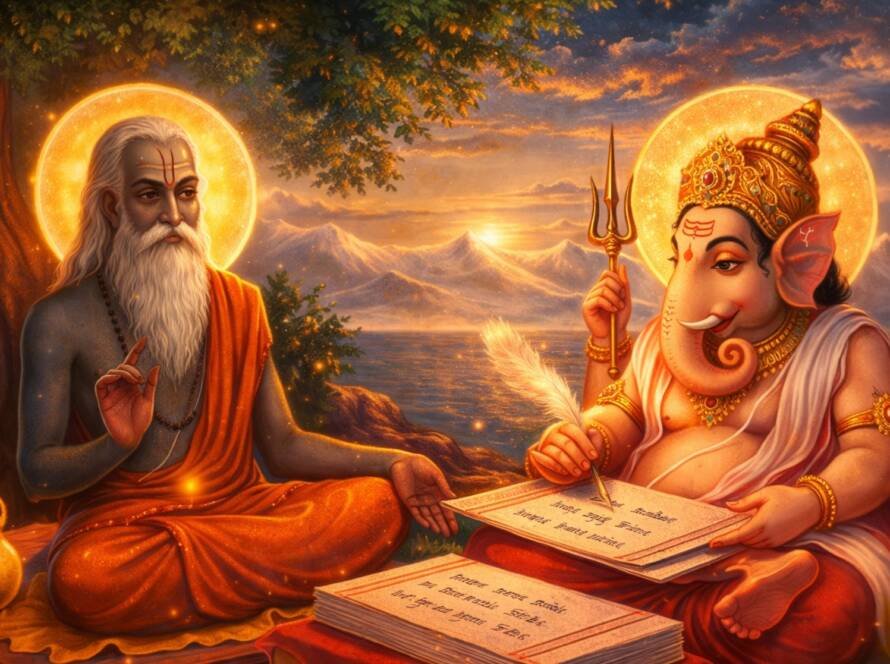
For thousands of years, this sacred knowledge was preserved not through writing, but through one of the most sophisticated oral traditions in human civilization. Through precise recitation, intonation, rhythm, and memory techniques, the Vedic mantras survived across generations with astonishing accuracy.
Śruti forms the foundational core of Sanātana Dharma, influencing spirituality, philosophy, ethics, rituals, music, language, sciences, and the cultural consciousness of India.
Meaning and Essence of Śruti
The Sanskrit root “श्रु” (śru) means to hear. Therefore, Śruti signifies knowledge that is:
- Divinely revealed
- Eternally existent
- Spiritually perceived
- Preserved through hearing and recitation
According to Vedic understanding, the universe itself vibrates with primordial sound. The Ṛṣis, through tapas (austerity), meditation, purity, and inner awakening, tuned their consciousness to these cosmic vibrations. What they perceived became the Vedic mantras.
Thus, the Vedas are not merely books. They are considered:
- Vibrational wisdom
- Sacred sound consciousness
- Eternal principles of existence
- Spiritual revelations encoded in mantra form
The importance of sound in Śruti is immense. In the Vedic worldview, sound (Nāda) is creative power. Creation itself is linked with divine vibration. Therefore, the exact pronunciation, meter, and tonal quality of Vedic recitation are treated as sacred and essential.
Why Śruti is Considered Divine
Śruti is revered because it is believed to transcend the limitations of ordinary human intellect. Human knowledge changes with time, culture, and perspective, but Śruti is regarded as timeless truth.
Several qualities distinguish Śruti from ordinary literature:
- Apauruṣeya – Non-Human Origin
The Vedas are not attributed to any single author. The Ṛṣis are known as “Mantra-draṣṭāraḥ” — the seers of the mantras, not their creators.
- Eternal Nature
Vedic wisdom is considered eternal, existing before creation itself and revealed repeatedly in each cosmic cycle.
- Preservation Through Sacred Oral Tradition
For millennia, Vedic knowledge was transmitted orally with exceptional precision using advanced recitation systems such as:
- Pada Pāṭha
- Krama Pāṭha
- Jatā Pāṭha
- Ghana Pāṭha
These methods ensured near-perfect preservation of every syllable and accent.
- Spiritual Authority
In Hindu philosophical traditions, Śruti is regarded as the highest source of spiritual knowledge and dharma.
The Structure of Śruti
Śruti primarily consists of the four Vedas and their associated layers of knowledge.
The Four Vedas
- Ṛgveda
The oldest Veda, containing hymns dedicated to various deities such as Agni, Indra, Varuṇa, Soma, and Uṣas. It reflects humanity’s earliest spiritual poetry and cosmic contemplation.
- Yajurveda
Focused on sacrificial rituals, procedures, and ceremonial formulas. It provides practical guidance for Vedic yajñas and sacred actions.
- Sāmaveda
The Veda of melodies and chants. It transforms Vedic mantras into musical forms and forms the origin of much of Indian sacred music and chanting traditions.
- Atharvaveda
Contains hymns related to daily life, healing, protection, philosophy, governance, cosmology, and spiritual practices.
The Four Layers Within Each Veda
Each Veda traditionally contains four major components.
- Saṁhitā
The collection of core hymns and mantras.
These include:
- Invocations
- Prayers
- Chants
- Cosmic hymns
- Ritual formulas
The Saṁhitās form the foundational body of Vedic revelation.
- Brāhmaṇa
These texts explain:
- Ritual meanings
- Sacrificial procedures
- Symbolism of yajñas
- Priestly duties
- Spiritual interpretations of rituals
They connect external ritual action with cosmic principles.
- Āraṇyaka
Known as the “forest texts,” these works represent a transition from ritualism toward meditation and contemplation.
They explore:
- Inner symbolism
- Meditative practices
- Mystical dimensions of sacrifice
- Philosophical inquiry
They were often studied by sages living in forests during later stages of life.
- Upaniṣad
The highest philosophical culmination of Śruti.
The Upaniṣads explore profound spiritual questions such as:
- What is the Self (Ātman)?
- What is ultimate reality (Brahman)?
- What is consciousness?
- What is liberation (Mokṣa)?
- What is the nature of existence?
Famous Mahāvākyas (great declarations) emerge from the Upaniṣads:
- “Tat Tvam Asi” — Thou Art That
- “Aham Brahmāsmi” — I Am Brahman
- “Prajnānam Brahma” — Consciousness is Brahman
The Upaniṣads shifted focus from external rituals to inner realization and became the philosophical foundation of Vedānta.
Śruti and Oral Preservation
One of humanity’s greatest intellectual achievements is the oral preservation system of the Vedas.
For centuries:
- The Vedas were never written down
- Knowledge passed directly from Guru to disciple
- Pronunciation and accent were rigorously maintained
- Memorization methods prevented alteration
The tonal accents known as:
- Udātta
- Anudātta
- Svarita
were carefully preserved because changes in sound could alter meaning and spiritual potency.
This oral tradition demonstrates the extraordinary discipline and reverence with which sacred knowledge was treated in ancient India.
Śruti and Cosmic Sound
Vedic philosophy deeply associates creation with sound vibration.
The sacred syllable Om (ॐ) is considered:
- The primordial cosmic vibration
- The seed of creation
- The essence of the Vedas
- The sound-symbol of Brahman
According to the Upaniṣads, all existence emerges from and dissolves back into this primordial sound-consciousness.
This idea later influenced:
- Nāda Yoga
- Mantra Śāstra
- Indian classical music
- Temple chanting traditions
- Spiritual meditation systems
Philosophical Importance of Śruti
Śruti became the foundation for nearly all schools of Hindu philosophy.
Different traditions interpreted the Vedas differently:
- Advaita Vedānta emphasized non-duality
- Viśiṣṭādvaita emphasized qualified non-dualism
- Dvaita emphasized dualism
- Yoga drew from Upaniṣadic meditative wisdom
- Mīmāṁsā emphasized ritual authority
Despite differing interpretations, all accepted the authority of Śruti.
Śruti and Smṛti
A major distinction exists between Śruti and Smṛti.
|
Śruti |
Smṛti |
|
Revealed knowledge |
Remembered tradition |
|
Divine and eternal |
Human-authored |
|
Highest authority |
Secondary authority |
|
Includes Vedas and Upaniṣads |
Includes epics, Purāṇas, Dharmaśāstras |
|
Immutable spiritual truth |
Adaptable social guidance |
Examples of Smṛti include:
- Mahābhārata
- Rāmāyaṇa
- Manusmṛti
- Purāṇas
Smṛti explains and applies the truths of Śruti for society and different eras.
Relevance of Śruti in the Modern World
Even today, Śruti remains profoundly relevant.
Its teachings inspire:
- Spiritual seekers
- Philosophers
- Scientists studying consciousness
- Musicians and sound researchers
- Yogic practitioners
- Scholars of comparative religion
Modern relevance includes:
- Meditation and mindfulness
- Sound healing traditions
- Ecological consciousness
- Universal spirituality
- Inquiry into consciousness and existence
The Upaniṣadic vision of unity, interconnectedness, and inner realization resonates strongly in the modern search for meaning and peace.
Conclusion
Śruti is not merely an ancient body of literature; it is the living spiritual heartbeat of Vedic civilization. It represents humanity’s deepest attempt to understand existence, consciousness, cosmic order, and the divine.
The Ṛṣis did not seek domination over nature — they sought harmony with the universal truth underlying all creation. Through silence, meditation, and inner awakening, they heard the eternal wisdom that became the Vedas.
For millennia, this revealed knowledge has guided seekers toward:
- Truth
- Self-realization
- Dharma
- Cosmic harmony
- Liberation
Śruti continues to remind humanity that ultimate wisdom is not merely intellectual information, but awakened consciousness — a direct realization of the eternal reality that pervades all existence.