Introduction
The Āraṇyakas form the third major layer of Vedic literature, standing between the Brāhmaṇas and the Upaniṣads. They represent one of the most significant transitions in the evolution of Vedic thought—from external ritual to internal contemplation.
While the Brāhmaṇas focus primarily on the philosophy and performance of Yajñas and sacred rituals, the Āraṇyakas begin to reinterpret these rituals in symbolic and psychological terms. They ask a profound question:
Is the true sacrifice performed only upon the external altar, or does it also take place within the human heart?
This shift marks the beginning of the inward journey that eventually culminates in the philosophical teachings of the Upaniṣads.
For this reason, the Āraṇyakas are often described as the bridge between ritual and realization, guiding the seeker from external worship toward inner spiritual awakening.
Meaning of the Word “Āraṇyaka”
The word Āraṇyaka is derived from the Sanskrit word Araṇya, meaning “forest.”
Thus, Āraṇyaka literally means “that which belongs to the forest” or “forest texts.”
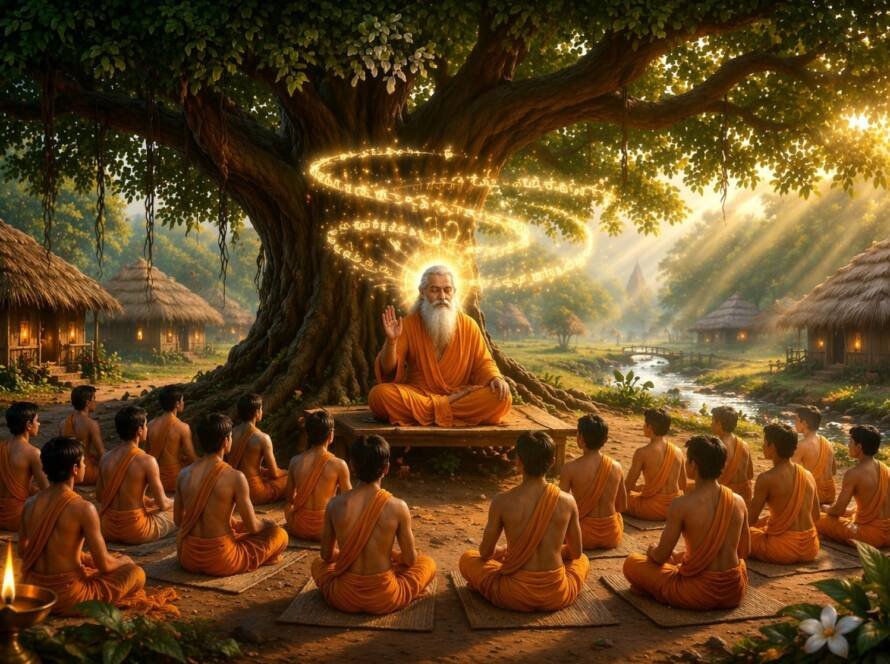
These texts were traditionally studied by sages who had withdrawn from worldly responsibilities and lived in forests during the later stage of life.
The peaceful atmosphere of the forest encouraged contemplation, meditation, and philosophical inquiry rather than elaborate ritual activity.
The forest therefore became a symbol of inner silence and spiritual reflection.
Position within Vedic Literature
Each Veda traditionally consists of four literary layers:
- Saṁhitā — Sacred hymns and mantras
- Brāhmaṇa — Ritual philosophy and ceremonial instruction
- Āraṇyaka — Symbolic interpretation and meditation
- Upaniṣad — Philosophical inquiry and Self-realization
The Āraṇyakas occupy the transitional position between ritual practice and spiritual philosophy.
They neither reject rituals nor remain confined to them.
Instead, they reinterpret rituals as symbols of inner transformation.
Why Were the Āraṇyakas Composed?
As Vedic thought evolved, many sages began asking deeper questions.
- Is external ritual sufficient for spiritual liberation?
- What is the inner meaning of sacrifice?
- Can the Divine be realized through meditation rather than ceremony?
- What is the relationship between the human being and the universe?
These questions required explanations that extended beyond ritual manuals.
The Āraṇyakas emerged to address these deeper dimensions of spiritual life.
They preserve the essence of ritual while directing attention toward contemplation and self-knowledge.
From Outer Ritual to Inner Sacrifice
One of the central teachings of the Āraṇyakas is that every external ritual possesses an inner counterpart.
For example:
- The sacred fire becomes the fire of knowledge.
- The altar becomes the human heart.
- The offerings become the surrender of ego and attachment.
- The Yajña becomes a process of inner purification.
Thus, rituals are no longer understood merely as physical ceremonies but as symbolic representations of spiritual growth.
The true Yajña ultimately takes place within the consciousness of the seeker.
Symbolism in the Āraṇyakas
The Āraṇyakas are rich in symbolic interpretation.
Natural elements and ritual objects are understood as expressions of universal truths.
Examples include:
- Fire symbolizes divine knowledge.
- The Sun represents supreme consciousness.
- Breath (Prāṇa) represents the sustaining force of life.
- Space symbolizes the infinite nature of Brahman.
- The human body is viewed as a sacred altar.
This symbolic approach gradually shifts attention from external observation to inner realization.
Meditation Becomes Central
Unlike the Brāhmaṇas, which emphasize ritual performance, the Āraṇyakas increasingly emphasize meditation and contemplation.
The seeker is encouraged to:
- Reflect upon the meaning of rituals.
- Observe the workings of the mind.
- Meditate upon the sacred syllable Om (Oṁ).
- Understand the unity between the individual and the universe.
The external act becomes less important than the consciousness with which it is performed.
The Forest as a Symbol
Although the Āraṇyakas were studied in forests, the forest also carries profound symbolic meaning.
The forest represents:
- Simplicity
- Silence
- Solitude
- Freedom from distractions
- Inner reflection
Leaving the village for the forest symbolizes leaving behind attachment, noise, and worldly preoccupations in order to discover one’s true Self.
The journey into the forest is ultimately a journey into one’s own consciousness.
Preparing for the Upaniṣads
The Āraṇyakas naturally lead into the Upaniṣads.
They gradually replace questions about ritual with questions about existence.
Instead of asking:
“How should a sacrifice be performed?”
they begin asking:
- Who am I?
- What is Brahman?
- What is the Self?
- What is immortality?
These are the very questions that become the central concern of the Upaniṣads.
Thus, the Āraṇyakas prepare the seeker intellectually and spiritually for the highest wisdom.
Major Āraṇyaka Texts
Some of the principal Āraṇyakas include:
- Aitareya Āraṇyaka — Ṛgveda
- Taittirīya Āraṇyaka — Kṛṣṇa Yajurveda
- Bṛhadāraṇyaka (forming part of the Bṛhadāraṇyaka Upaniṣad tradition)
- Kauṣītaki Āraṇyaka
Many famous Upaniṣads originally developed from these Āraṇyakas, illustrating the natural progression from symbolic ritual to philosophical inquiry.
Relevance in the Modern World
The message of the Āraṇyakas remains deeply relevant today.
Modern life is often filled with activity, distraction, and external achievement.
The Āraṇyakas remind us that spiritual growth also requires:
- Silence
- Reflection
- Self-observation
- Meditation
- Simplicity
- Inner awareness
They teach that rituals become meaningful only when accompanied by understanding and inner transformation.
Their wisdom encourages individuals to balance outer responsibilities with inner contemplation.
Conclusion
The Āraṇyakas represent one of the most profound turning points in Vedic philosophy. They preserve the sacred rituals of the Vedic tradition while revealing their deeper symbolic and psychological significance.
By guiding the seeker from external ceremonies to inner contemplation, they form the essential bridge between the Brāhmaṇas and the Upaniṣads.
Their enduring message is that the highest sacrifice is not merely performed upon the external altar but within the human heart, where ego is surrendered, wisdom is awakened, and the individual begins the journey toward Self-realization.