Introduction
The Brāhmaṇas form the second major layer of Vedic literature, following the Saṁhitās and preceding the Āraṇyakas and Upaniṣads. While the Saṁhitās contain the sacred hymns and mantras, the Brāhmaṇas explain how these mantras are to be used in rituals and, more importantly, why those rituals are performed.
The Brāhmaṇas are not merely manuals of ceremonial procedures. They present a profound philosophy of ritual, revealing that every Vedic sacrifice (Yajña) is an expression of cosmic order, spiritual discipline, and the relationship between humanity and the Divine.
Their central purpose is to demonstrate that rituals are not empty formalities but meaningful acts that connect the visible world with the invisible principles governing the universe.
For this reason, the Brāhmaṇas are best understood as the philosophy of Vedic ritual rather than simply ritual instruction.
Meaning of the Word “Brāhmaṇa”
The word Brāhmaṇa is derived from Brahman, which in the Vedic context refers to sacred knowledge, the power of the Vedic mantras, and the ultimate spiritual reality.
Brāhmaṇa texts are therefore those that explain:
- The meaning of Vedic mantras
- The procedures of Yajñas and rituals
- The symbolism behind ceremonial actions
- The spiritual purpose of sacrificial worship
Rather than focusing only on how a ritual should be performed, the Brāhmaṇas explore why it is spiritually significant.
Position within Vedic Literature
Every Veda has its own associated Brāhmaṇa texts.
Some of the most important are:
- Aitareya Brāhmaṇa — Ṛgveda
- Śatapatha Brāhmaṇa — Śukla Yajurveda
- Taittirīya Brāhmaṇa — Kṛṣṇa Yajurveda
- Pañcaviṁśa Brāhmaṇa — Sāmaveda
- Gopatha Brāhmaṇa — Atharvaveda
Together, these works preserve the ritual traditions and theological insights associated with their respective Vedas.
Purpose of the Brāhmaṇas
The Brāhmaṇas serve several important purposes.
They explain:
- Which rituals should be performed
- When and where they should be conducted
- Which mantras accompany each ritual
- The duties of the officiating priests
- The symbolic meaning of every ritual action
Their purpose is not simply procedural but educational. They help practitioners understand the spiritual principles underlying sacred ceremonies.
Yajña as a Sacred Philosophy
One of the central themes of the Brāhmaṇas is Yajña.
In these texts, Yajña is far more than offering substances into a sacred fire.
It represents:
- Self-offering
- Discipline
- Gratitude
- Cooperation with the cosmic order
- The continuous exchange that sustains life
Every ritual becomes a symbolic expression of humanity’s participation in the universal harmony established by the Divine.
Thus, sacrifice is understood not as destruction, but as transformation.
Ritual and Cosmic Order
The Brāhmaṇas teach that the universe operates according to a sacred order known as Ṛta.
Human beings participate in this cosmic order through righteous actions and properly performed rituals.
The purpose of Yajña is therefore to maintain harmony between:
- Humanity
- Nature
- The Devas
- And the universe itself
By participating consciously in sacred rituals, individuals align themselves with the universal laws governing existence.
Symbolism in the Brāhmaṇas
One of the most remarkable features of the Brāhmaṇas is their rich symbolic interpretation of rituals.
Every component of a Yajña carries a deeper meaning.
For example:
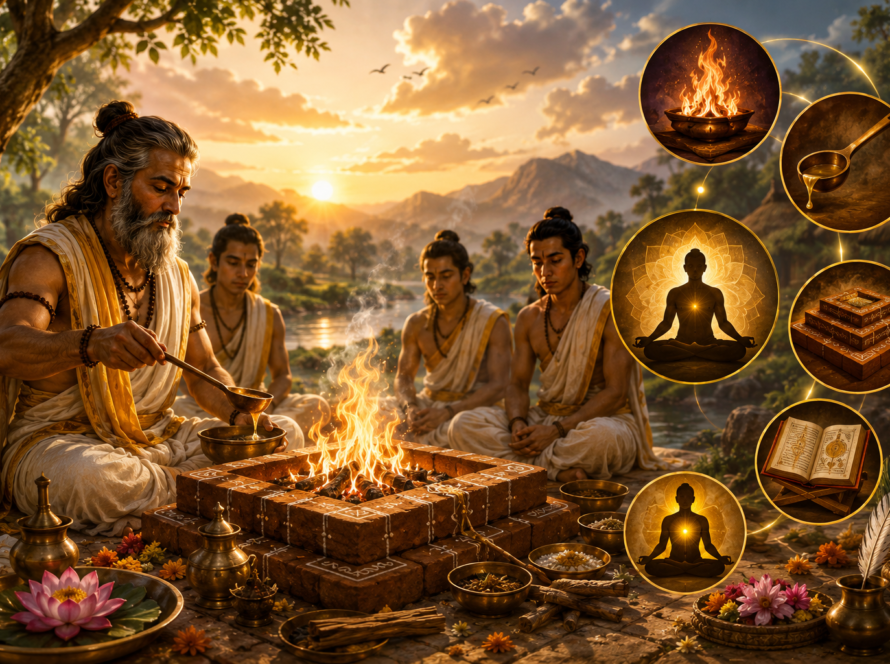
- Agni (Fire) symbolizes divine knowledge, purification, and transformation.
- Ghee (Ghṛta) represents devotion, faith, and selfless offering.
- The Altar symbolizes the universe itself.
- The Offering (Āhuti) represents the surrender of ego and attachment.
- Smoke symbolizes prayers and aspirations rising toward the Divine.
Through these symbolic interpretations, external rituals become reflections of inner spiritual processes.
Mythology and Sacred Narratives
The Brāhmaṇas also contain numerous myths, legends, and symbolic stories.
These narratives explain:
- The origin of rituals
- The significance of sacred ceremonies
- The relationship between the Devas and humanity
- Moral and spiritual lessons
- Cosmic principles expressed through symbolic events
Many of these stories later influenced the Purāṇas, Epics, and other classical works of Hindu literature.
From Ritual to Contemplation
The Brāhmaṇas represent an important transitional stage in Vedic thought.
While they emphasize ritual action, they also begin asking deeper questions:
- What is the inner meaning of sacrifice?
- Is the true Yajña external or internal?
- Can spiritual realization be attained through inner transformation rather than ritual alone?
These questions gradually lead into the Āraṇyakas, where the emphasis shifts from external ceremonies to meditation, symbolism, and contemplation.
In this way, the Brāhmaṇas serve as a bridge between ritual practice and philosophical inquiry.
Relevance in the Modern World
Although elaborate Vedic sacrifices are no longer a part of everyday life for most people, the philosophical insights of the Brāhmaṇas remain highly relevant.
They teach that:
- Every action should have purpose and awareness.
- Outer actions gain meaning through inner intention.
- Discipline and sincerity are essential in all spiritual practices.
- Every selfless act performed with dedication can become a sacred offering.
The Brāhmaṇas remind us that spirituality is not limited to rituals but is expressed through the attitude with which every action is performed.
Conclusion
The Brāhmaṇas occupy a vital place within Vedic literature by connecting sacred mantras with meaningful action and ritual with philosophy. They reveal that Yajña is not merely an external ceremony but a profound expression of cosmic harmony, spiritual discipline, and inner transformation.
By uncovering the symbolic and philosophical dimensions of ritual, the Brāhmaṇas transformed ceremonial worship into a path of self-understanding and spiritual growth.
Their enduring message is that every action performed with knowledge, devotion, discipline, and selfless intention becomes a sacred act, bringing the individual into harmony with the Divine and the universal order.