Introduction
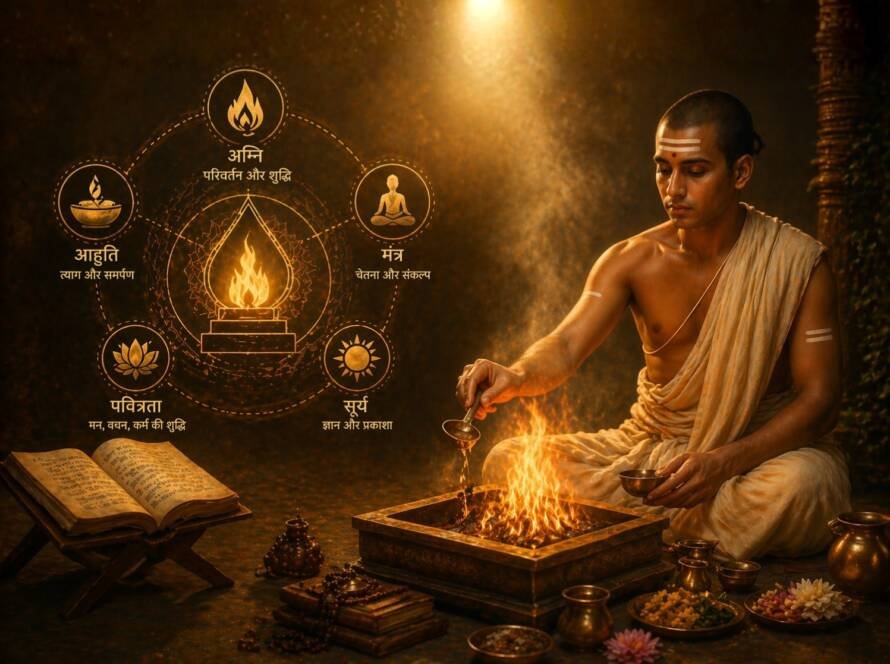
One of the most profound developments in Vedic philosophy is the internalization of sacrifice. In the early Vedic period, Yajña (sacrifice) was primarily understood as an external ritual involving sacred fire, mantras, offerings, and priests. These rituals were performed to express gratitude, maintain harmony with the cosmic order (Ṛta), and strengthen the relationship between humanity and the Divine.
As Vedic thought evolved through the Brāhmaṇas, Āraṇyakas, and ultimately the Upaniṣads, the understanding of sacrifice became increasingly inward. The sages began to ask a deeper question:
Is the highest sacrifice performed on the external altar, or within the human heart?
Their answer transformed the entire understanding of Yajña. The true sacrifice, they taught, is not merely the offering of external substances into a sacred fire, but the offering of one’s ego, ignorance, desires, and attachments into the fire of wisdom.
This shift from outer ritual to inner realization became one of the defining characteristics of the Upaniṣadic vision.
The Early Understanding of Sacrifice
In the earliest Vedic tradition, sacrifice was an essential part of religious and social life.
A typical Yajña involved:
- Sacred fire (Agni)
- Vedic mantras
- Offerings of ghee, grains, herbs, and other sacred substances
- Priests performing prescribed rituals
- Prayers for harmony, prosperity, and spiritual well-being
These sacrifices were never considered acts of appeasing the Divine. Rather, they expressed humanity’s participation in the cosmic order through gratitude, discipline, and selfless offering.
Why Did the Understanding Change?
As spiritual inquiry deepened, the Vedic sages recognized that rituals alone could not lead to the highest realization.
They began asking:
- What is the real purpose of sacrifice?
- Who is the true sacrificer?
- What is the ultimate offering?
- Where does the highest Yajña actually take place?
These questions marked the transition from ritual-centered spirituality to contemplative philosophy.
The emphasis gradually shifted from external performance to inner transformation.
The Āraṇyakas: The Beginning of Inner Interpretation
The Āraṇyakas were the first texts to reinterpret Vedic rituals symbolically.
Instead of abandoning Yajña, they explained its deeper meaning.
For example:
- The sacred fire became the fire of knowledge.
- The altar became the human heart.
- The offerings became the surrender of ego.
- The ritual became a process of inner purification.
The external ceremony now reflected an internal spiritual discipline.
The Upaniṣadic Transformation
The Upaniṣads carried this development even further.
They taught that the ultimate purpose of sacrifice is Self-realization.
The greatest offering is not material wealth but:
- Ego
- Ignorance (Avidyā)
- Attachment
- Desire
- Pride
- False identification with the body and mind
These are to be offered into the fire of spiritual knowledge.
The external Yajña thus becomes an inner journey toward liberation.
The Fire Within
The Vedic tradition recognizes that the true sacred fire also exists within every individual.
This inner Agni appears as:
- The fire of knowledge that removes ignorance.
- The fire of discrimination (Viveka) that distinguishes truth from illusion.
- The fire of aspiration that inspires spiritual growth.
- The fire of discipline that purifies character.
The real altar is the heart, and the real priest is awakened consciousness.
Internal Yajña in Daily Life
The internalization of sacrifice transforms everyday life into spiritual practice.
Every act of:
- Forgiveness
- Compassion
- Self-control
- Charity
- Truthfulness
- Patience
- Service
becomes a sacred offering.
Likewise, every victory over anger, greed, jealousy, or pride becomes an inner Yajña.
The seeker no longer limits sacrifice to ceremonial occasions but makes every moment an opportunity for spiritual growth.
The Bhagavad Gītā and Inner Sacrifice
The Bhagavad Gītā expands the Vedic concept of sacrifice beyond ritual fire.
Lord Kṛṣṇa describes many forms of Yajña, including:
- Sacrifice through knowledge (Jñāna Yajña)
- Sacrifice through self-discipline
- Sacrifice through meditation
- Sacrifice through breath control
- Sacrifice through selfless action
Among these, the Gītā praises Jñāna Yajña as one of the highest forms because knowledge destroys ignorance, which is the root of bondage.
The emphasis shifts from external offerings to the transformation of consciousness.
The Symbolism of Inner Sacrifice
The symbolism of internal sacrifice can be understood through the elements of a traditional Yajña.
| External Ritual | Inner Meaning |
|---|---|
| Sacred Fire | Knowledge and spiritual awareness |
| Altar | The human heart |
| Ghee | Devotion and sincerity |
| Offerings | Ego, desires, and attachments |
| Smoke | Purified thoughts rising toward the Divine |
| Priest | The awakened intellect guided by wisdom |
This symbolic interpretation reveals that the real purpose of ritual is to transform the individual.
Relevance in the Modern World
The internalization of sacrifice makes the Vedic tradition universally relevant.
Many people today may not perform elaborate Vedic rituals, yet everyone can practice the essence of Yajña.
Whenever a person:
- Chooses truth over falsehood,
- Serves others selflessly,
- Controls harmful desires,
- Cultivates compassion,
- Seeks wisdom,
that individual performs an inner sacrifice.
Thus, the highest Yajña is available to every sincere seeker regardless of time, place, or circumstance.
Conclusion
The internalization of sacrifice represents one of the greatest philosophical achievements of the Vedic tradition. It transformed Yajña from an external ceremony into a universal spiritual discipline centered upon self-transformation.
The sages taught that while rituals have their place, their highest purpose is to awaken inner awareness. The real offering is the surrender of ego, ignorance, and attachment into the fire of wisdom.
The enduring message of this teaching is that the greatest sacrifice is not what we place upon the external altar, but what we willingly surrender within ourselves. When the ego is offered into the fire of knowledge, the individual moves from ritual to realization and from action to liberation.