Introduction
The Vedic tradition presents a comprehensive path for human development that gradually leads an individual from external practice to inner realization. To accommodate people at different stages of spiritual evolution, Vedic teachings are broadly classified into two complementary divisions:
- Karma-kāṇḍa — the section dealing with righteous actions, rituals, and duties.
- Jñāna-kāṇḍa — the section devoted to spiritual wisdom, self-realization, and the knowledge of the Absolute.
Rather than representing two opposing philosophies, Karma-kāṇḍa and Jñāna-kāṇḍa are two stages of the same spiritual journey. The former prepares the individual through disciplined action, while the latter leads to the direct realization of ultimate truth.
Together, they form a complete path that guides a seeker from external worship to inner enlightenment.
What is Karma-kāṇḍa?
The Sanskrit word Karma means “action,” while Kāṇḍa means “section” or “division.”
Thus, Karma-kāṇḍa refers to the portion of the Vedas that teaches:
- Yajñas (sacrificial rituals)
- Sacred ceremonies
- Duties (Dharma)
- Ethical conduct
- Worship
- Social responsibilities
Its primary concern is teaching individuals how to live in harmony with the cosmic order through righteous action.
The Karma-kāṇḍa is mainly represented by:
- The Saṁhitās
- The Brāhmaṇas
These texts provide the mantras, rituals, and ceremonial procedures that cultivate discipline, gratitude, and devotion.
Purpose of Karma-kāṇḍa
The purpose of Karma-kāṇḍa is not merely to perform rituals.
Its deeper objectives are:
- Purification of the mind
- Cultivation of discipline
- Development of selflessness
- Fulfillment of social and moral responsibilities
- Harmonizing human life with Dharma
Every ritual is intended to transform the individual internally while maintaining harmony in the external world.
Thus, rituals are viewed as a means of spiritual preparation rather than an end in themselves.
What is Jñāna-kāṇḍa?
Jñāna means “knowledge,” particularly spiritual knowledge that leads to liberation.
Jñāna-kāṇḍa refers to the philosophical section of the Vedas that explores:
- The nature of the Self (Ātman)
- Brahman (Ultimate Reality)
- Consciousness
- Liberation (Mokṣa)
- The purpose of existence
This section is primarily represented by:
- The Āraṇyakas
- The Upaniṣads
Instead of emphasizing external rituals, these texts encourage inquiry, contemplation, meditation, and direct realization.
Their central question is not “How should one perform a ritual?” but “Who am I?”
Purpose of Jñāna-kāṇḍa
The ultimate goal of Jñāna-kāṇḍa is Self-realization.
It teaches that ignorance (Avidyā) is the root cause of suffering.
Liberation comes not through external actions alone but through the realization that:
- The individual Self (Ātman)
- And the Supreme Reality (Brahman)
are ultimately inseparable.
Thus, knowledge becomes the highest means of attaining freedom.
Karma and Jñāna as Complementary Paths
The Vedic tradition does not present Karma and Jñāna as rivals.
Instead, they complement one another.
Karma prepares the mind.
Jñāna liberates the mind.
Without purification through righteous action, higher knowledge may remain merely intellectual.
Without wisdom, actions may become mechanical and driven by ego.
The two therefore function together:
- Karma refines.
- Jñāna illuminates.
The Journey from Ritual to Realization
The Vedas present spiritual growth as a gradual process.
A seeker first learns:
- Discipline
- Worship
- Duty
- Self-control
- Service
These qualities prepare the mind for deeper inquiry.
Once the mind becomes calm and pure, the seeker naturally turns toward questions such as:
- Who am I?
- What is the nature of reality?
- What is the purpose of life?
- What is the source of consciousness?
This marks the transition from Karma-kāṇḍa to Jñāna-kāṇḍa.
External rituals gradually become internal meditation.
Examples of the Transition
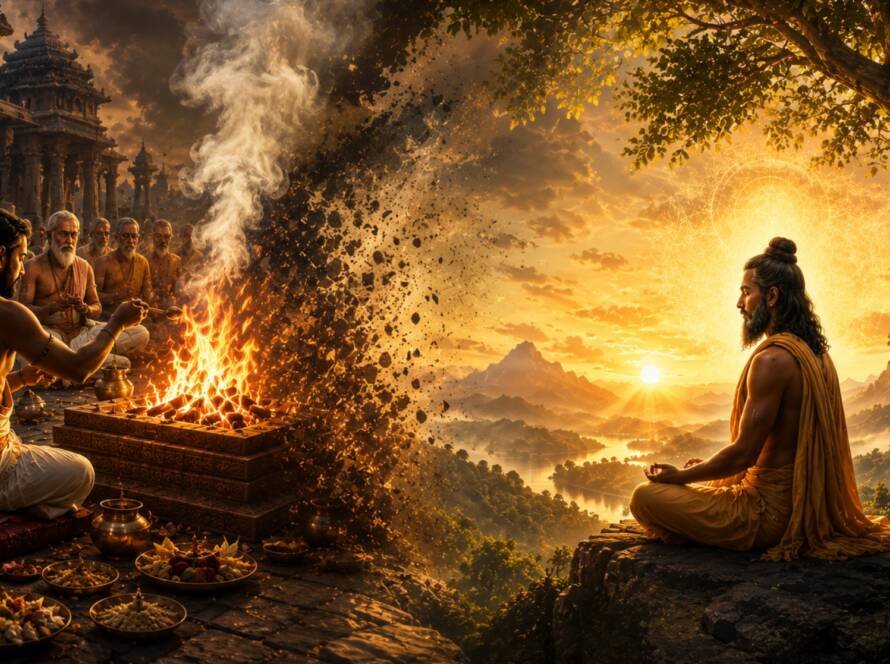
The symbolism of Yajña beautifully illustrates this evolution.
In Karma-kāṇḍa:
- Fire is external.
- Offerings are physical.
- Rituals are performed outwardly.
In Jñāna-kāṇḍa:
- Fire becomes the fire of wisdom.
- Offerings become the surrender of ego.
- The altar becomes the human heart.
- The sacrifice becomes inner transformation.
Thus, the outer ceremony evolves into an inner spiritual experience.
Teachings of the Upaniṣads
The Upaniṣads repeatedly affirm that rituals alone cannot grant ultimate liberation.
Instead, they encourage seekers to inquire into the nature of the Self.
Mahāvākyas such as:
- Tat Tvam Asi (“That Thou Art”)
- Aham Brahmāsmi (“I am Brahman”)
- Prajñānam Brahma (“Consciousness is Brahman”)
represent the culmination of Jñāna-kāṇḍa.
These declarations shift attention from external worship to direct spiritual realization.
The Bhagavad Gītā: A Synthesis of Both
The Bhagavad Gītā harmonizes Karma and Jñāna rather than choosing one over the other.
Lord Kṛṣṇa teaches that:
- Actions should be performed selflessly.
- Knowledge should guide action.
- Devotion should purify both.
The Gītā presents Karma Yoga, Jñāna Yoga, and Bhakti Yoga as complementary paths leading toward the same ultimate realization.
Relevance in the Modern World
The distinction between Karma-kāṇḍa and Jñāna-kāṇḍa remains meaningful today.
Many people begin their spiritual journey through:
- Prayer
- Worship
- Rituals
- Service
As their understanding deepens, they naturally seek:
- Meditation
- Self-inquiry
- Philosophy
- Inner awareness
The Vedic tradition recognizes that both stages are valuable and necessary.
Action without wisdom may become empty routine.
Knowledge without disciplined living may remain theoretical.
Together, they create a balanced spiritual life.
Conclusion
Karma-kāṇḍa and Jñāna-kāṇḍa are not competing systems but complementary dimensions of Vedic wisdom.
Karma-kāṇḍa teaches how to live righteously through disciplined action, sacred rituals, and selfless service.
Jñāna-kāṇḍa reveals the highest truth through inquiry, contemplation, and realization of the Self.
One prepares the seeker; the other fulfills the seeker’s quest.
The enduring message of the Vedic tradition is that right action purifies the mind, and true knowledge liberates it. When disciplined action and spiritual wisdom unite, the individual progresses from ritual to realization, from external worship to inner awakening, and ultimately to the realization of Brahman.