Introduction
Among the four Vedas, the Sāmaveda holds a unique and sacred position. If the Ṛgveda is the Veda of knowledge, the Yajurveda the Veda of ritual action, and the Atharvaveda the Veda of practical wisdom, then the Sāmaveda is rightly known as the Veda of music, sacred sound, and spiritual consciousness.
The word Sāmaveda is derived from:
- Sāma — melody, musical chant, or harmonious song
- Veda — knowledge
Thus, Sāmaveda means “The Knowledge of Sacred Melodies.”
Although most of its verses are drawn from the Ṛgveda, the Sāmaveda transforms these hymns into musical expressions through specific tonal patterns and melodic structures. Its focus is not merely on the words of the mantras, but on the transformative power of sound itself.
For this reason, the Sāmaveda is regarded as the foundation of:
- Vedic chanting
- Indian classical music
- Nāda Yoga (the Yoga of Sound)
- Sacred musical traditions
- Meditative sound practices
At its heart lies a profound insight: sound has the power to elevate consciousness and connect the individual with the divine.
The Nature of the Sāmaveda
Among the four Vedas, the Sāmaveda is the smallest in size but one of the most influential in spiritual practice.
It contains approximately:
- 1,875 verses
- Most of which originate from the Ṛgveda
What makes the Sāmaveda unique is not the content of the verses themselves, but the way they are sung.
The central purpose of the Sāmaveda is:
To transform sacred knowledge into lived spiritual experience through sound.
The sages understood that melody and vibration can affect the human mind and consciousness in ways that ordinary speech cannot.
What is Nāda?
The Meaning of Nāda
The Sanskrit word Nāda means:
- Sound
- Vibration
- Resonance
- Subtle cosmic movement
According to Vedic thought, the universe is fundamentally vibrational in nature. Everything that exists is in a state of movement and resonance.
The ancient sages realized that:
- Sound influences the mind,
- The mind influences consciousness,
- And consciousness shapes human experience.
Therefore, Nāda is not merely physical sound but a manifestation of the deeper reality underlying existence.
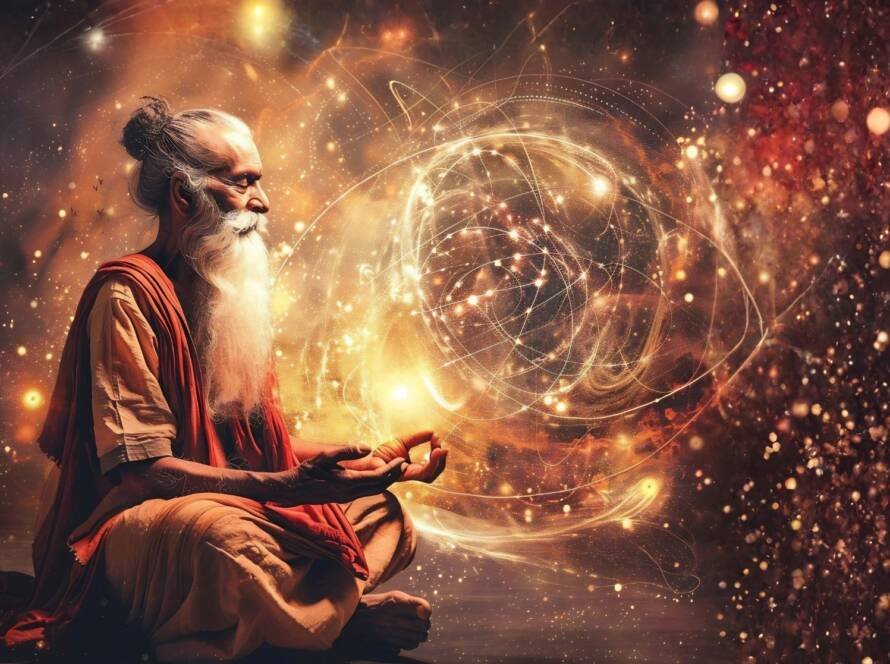
Nāda Brahma — “The Universe is Sound”
One of the most profound ideas associated with the Sāmaveda is:
Nāda Brahma
Meaning:
“The universe is sound” or “Sound is Brahman.”
This concept teaches that creation itself originates from primordial vibration.
According to this view:
- The cosmos emerged from sound,
- Is sustained through vibration,
- And ultimately dissolves back into its source.
The Sāmaveda explores this sacred relationship between sound and existence.
Om — The Primordial Sound
The sacred syllable Om (ॐ) occupies a central place in Vedic spirituality.
Om is regarded as:
- The primordial vibration
- The first cosmic sound
- The seed of creation
- The sonic expression of Brahman
The Upaniṣads describe Om as the essence of all speech, all sound, and all existence.
The musical and spiritual traditions of the Sāmaveda are rooted in this understanding of sacred vibration.
Sāmaveda and the Origins of Music
The Birth of Indian Musical Tradition
The Sāmaveda is traditionally considered the source of Indian classical music.
The Vedic sages observed that:
- Different tones affect the mind differently,
- Melody can alter emotional states,
- Rhythm can influence awareness,
- Sacred sound can elevate consciousness.
As a result, Vedic hymns began to be sung according to precise tonal patterns rather than merely recited.
Over time, this tradition evolved into:
- The seven musical notes (Sa, Re, Ga, Ma, Pa, Dha, Ni)
- Rāga systems
- Classical vocal traditions
- Temple music and devotional singing
For this reason, Sāmaveda is often called the spiritual ancestor of Indian music.
Sāmagāna — The Sacred Chanting Tradition
The musical recitation of Sāmavedic hymns is known as Sāmagāna.
Sāmagāna is characterized by:
- Precise tonal structures
- Melodic chanting
- Rhythmic patterns
- Meditative resonance
The purpose of Sāmagāna is not artistic performance but spiritual elevation.
The chant itself becomes a form of meditation and communion with the sacred.
Music and Consciousness
One of the foundational insights of the Sāmaveda is that:
Sound can transform consciousness.
The sages recognized that sacred music can:
- Calm the mind
- Refine emotions
- Increase concentration
- Create inner harmony
- Support spiritual awakening
This understanding explains why music and chanting became essential elements of Vedic rituals and spiritual practice.
Sāmaveda and Meditation
The Sāmaveda presents sound as a pathway to inner stillness.
When a practitioner:
- Listens deeply,
- Focuses on sacred tones,
- Repeats mantras with awareness,
- And merges attention with sound,
the restless mind gradually becomes calm and concentrated.
This principle later influenced:
- Mantra Yoga
- Nāda Yoga
- Bhakti music traditions
- Kīrtana and devotional singing
- Meditative chanting practices
Nāda Yoga and the Sāmaveda
What is Nāda Yoga?
Nāda Yoga is the spiritual path that uses sound as a means of self-realization.
Its goal is:
- To move from external sound to inner sound,
- From mental activity to stillness,
- And from sensory awareness to spiritual consciousness.
The philosophical roots of Nāda Yoga can be traced back to the sound-centered teachings of the Sāmaveda.
Āhata and Anāhata Nāda
Indian spiritual traditions distinguish between two forms of sound.
Āhata Nāda (Struck Sound)
Sound produced by physical contact or vibration, such as:
- Musical instruments
- Human voices
- Chanting
- Spoken words
Anāhata Nāda (Unstruck Sound)
A subtle inner sound perceived during deep meditation.
According to yogic traditions, advanced practitioners may experience this inner vibration as consciousness becomes increasingly refined.
The journey from external sound to inner sound is a central theme in Nāda Yoga.
Sāmaveda and Bhakti
The influence of the Sāmaveda extends deeply into India’s devotional traditions.
Many practices such as:
- Bhajans
- Kīrtanas
- Temple chanting
- Sacred hymns
- Devotional music
reflect the Sāmavedic understanding that music can become a vehicle for spiritual experience.
In Bhakti traditions, singing is not merely artistic expression but an act of worship and divine communion.
Sound, Science, and Modern Understanding
Modern research increasingly recognizes that sound can influence:
- Brainwave patterns
- Emotional states
- Stress levels
- Concentration
- Psychological well-being
While modern science and Vedic philosophy approach the subject differently, both acknowledge that sound profoundly affects human experience.
The Sāmaveda anticipated this insight thousands of years ago by exploring the relationship between vibration and consciousness.
Relevance of the Sāmaveda Today
The teachings of the Sāmaveda remain highly relevant in the modern world.
Its principles continue to inspire:
- Meditation practices
- Sound healing traditions
- Yoga
- Music therapy
- Mindfulness disciplines
- Sacred chanting traditions
- Spiritual development
In an age of constant distraction, the Sāmaveda reminds us of the transformative power of attentive listening and sacred sound.
Conclusion
The Sāmaveda is far more than a collection of chants. It is a profound exploration of Nāda (sound), music, and consciousness.
It teaches that the universe is fundamentally vibrational and that sound can serve as a bridge between the human mind and the deeper dimensions of reality.
Through melody, rhythm, and sacred chanting, the Sāmaveda transforms knowledge into experience and sound into spiritual awakening.
Its timeless message is that when sound becomes meditation, music becomes worship, and consciousness merges with the sacred vibration of existence, the seeker moves closer to the realization of the Divine.